Array Imaging
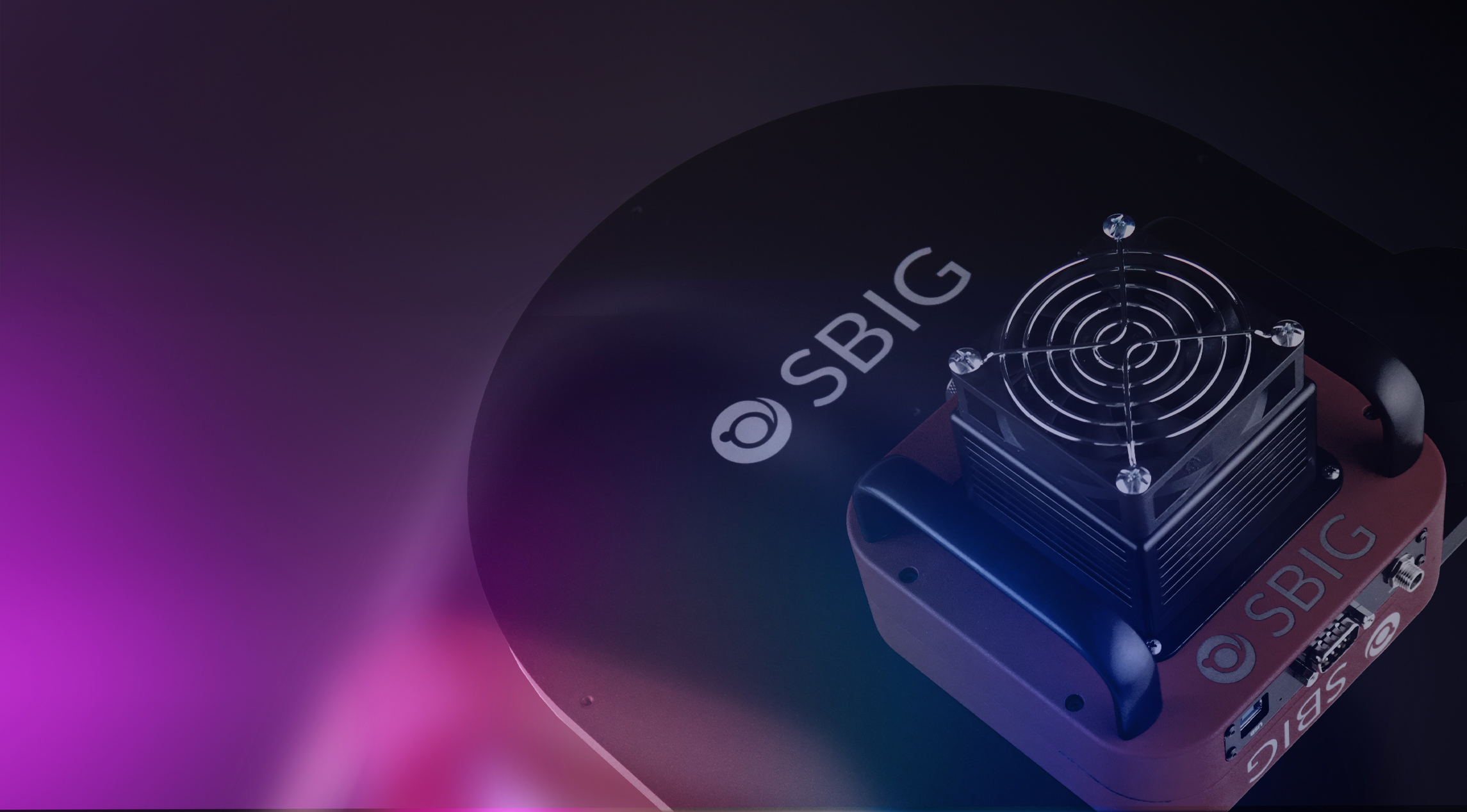
Scientific Imaging at Scale
Modern astronomical and scientific instruments increasingly use arrays of cameras and telescopes to achieve capabilities that would be difficult or prohibitively expensive with a single large instrument.
These systems can take many forms. Hundreds or thousands of optical systems can operate together on a common structure. Multiple telescopes can share a smaller number of mounts. Groups of coordinated instruments can simultaneously observe the same target in different spectral bands or operate independently when required.
Diffraction Limited has extensive experience designing and manufacturing scientific cameras for these applications—from the Dragonfly Telephoto Array to more than 1,200 custom cameras for the Argus Array.
We can adapt our camera technology, firmware, networking, mechanical interfaces, cooling systems, software, and production processes to become an integral part of the complete instrument.
The Argus Array
Courtesy University of North Carolina at Chapel Hill
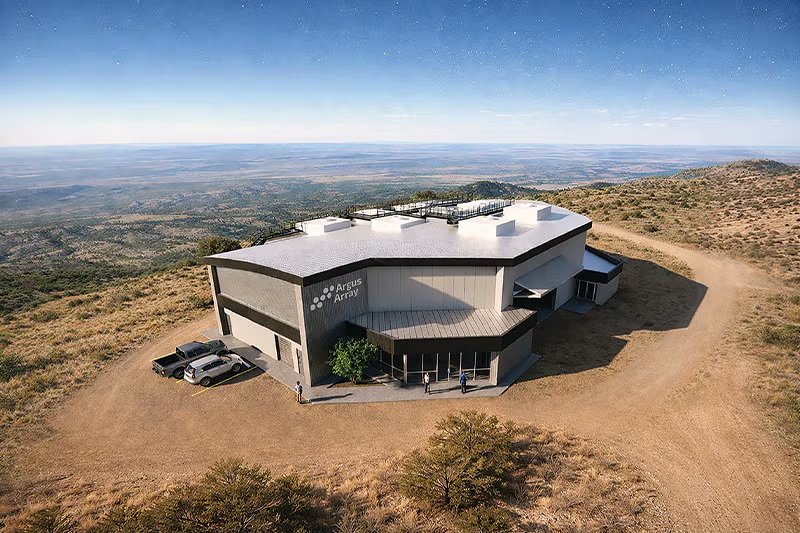
The Argus Array, part of the Eric and Wendy Schmidt Observatory System, co-funded by Alex Gerko, is a new astronomical observatory being developed by the University of North Carolina at Chapel Hill.
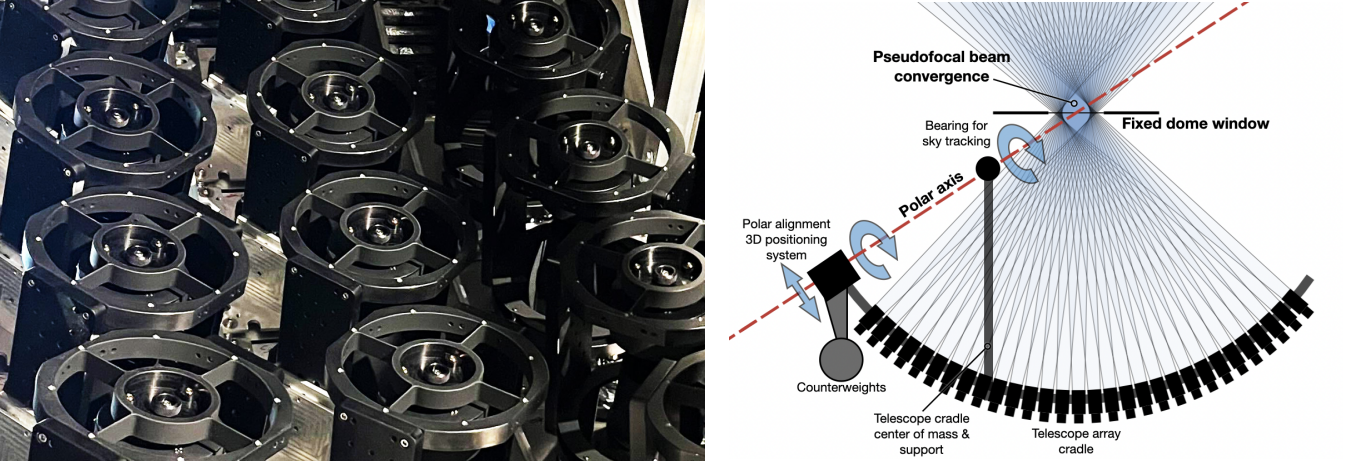
Argus takes a fundamentally different approach to wide-field astronomy. More than 1,200 individual telescopes are arranged in a roughly dish-shaped structure carried by an enormous common telescope mount. Together they continuously observe a vast portion of the Northern sky.
The completed system will provide an approximately 8,000-square-degree instantaneous field of view, with each exposure containing approximately 120 gigapixels. The result will be a deep, high-cadence movie of the changing night sky.
Diffraction Limited is supplying over 1,200 custom scientific cameras at the heart of the Argus Array.
 Courtesy University of North Carolina at Chapel Hill
Custom Engineered for Argus
The Argus camera began with our Aluma AC461 platform and its 102-megapixel Sony IMX461 back-illuminated CMOS sensor, but the resulting production camera is extensively customized for the observatory.
The mechanical design interfaces directly with the Argus focusing system. A quick-release liquid-cooling interface developed by UNC has been integrated into the camera, allowing cameras to be rapidly installed and replaced.
Electrical and network interfaces have also been customized. Additional network connectivity supports external systems including the focuser, while custom API features integrate the camera directly into the observatory control architecture.
Each camera connects directly to the Argus network. Management capabilities include IP address configuration, remote firmware updates, and other functions required to operate and maintain a fleet of more than 1,200 network-connected scientific cameras.
The result isn’t simply a modified catalog camera. It is a camera engineered as a component of a much larger scientific instrument.
 Customized Argus 461 camera
Manufacturing 100 Scientific Cameras a Month
Building more than 1,200 large format scientific cameras requires a very different production approach from manufacturing instruments individually.
For Argus, Diffraction Limited has established a sustained production rate of approximately 100 scientific cameras per month, while maintaining the testing, calibration, traceability, and quality controls expected of a scientific instrument.
Our guided, largely automated test system leads the assembler through the test process, performs measurements automatically, and records the results directly into our production database.
Every camera therefore has an individual production and calibration history. The complete test and calibration information for the Argus cameras will be provided to UNC.
This traceability isn’t unique to Argus. Test and calibration results are recorded for every camera we manufacture.
Reliability was also considered at the component level. Where appropriate, components with potential lifetime limitations were replaced with longer-life alternatives to better match the expected operating life of the observatory.
The cameras themselves are interchangeable within the array. Different spectral filters are distributed throughout the instrument, and individual cameras are tracked within the observatory so they can be serviced or replaced as required.
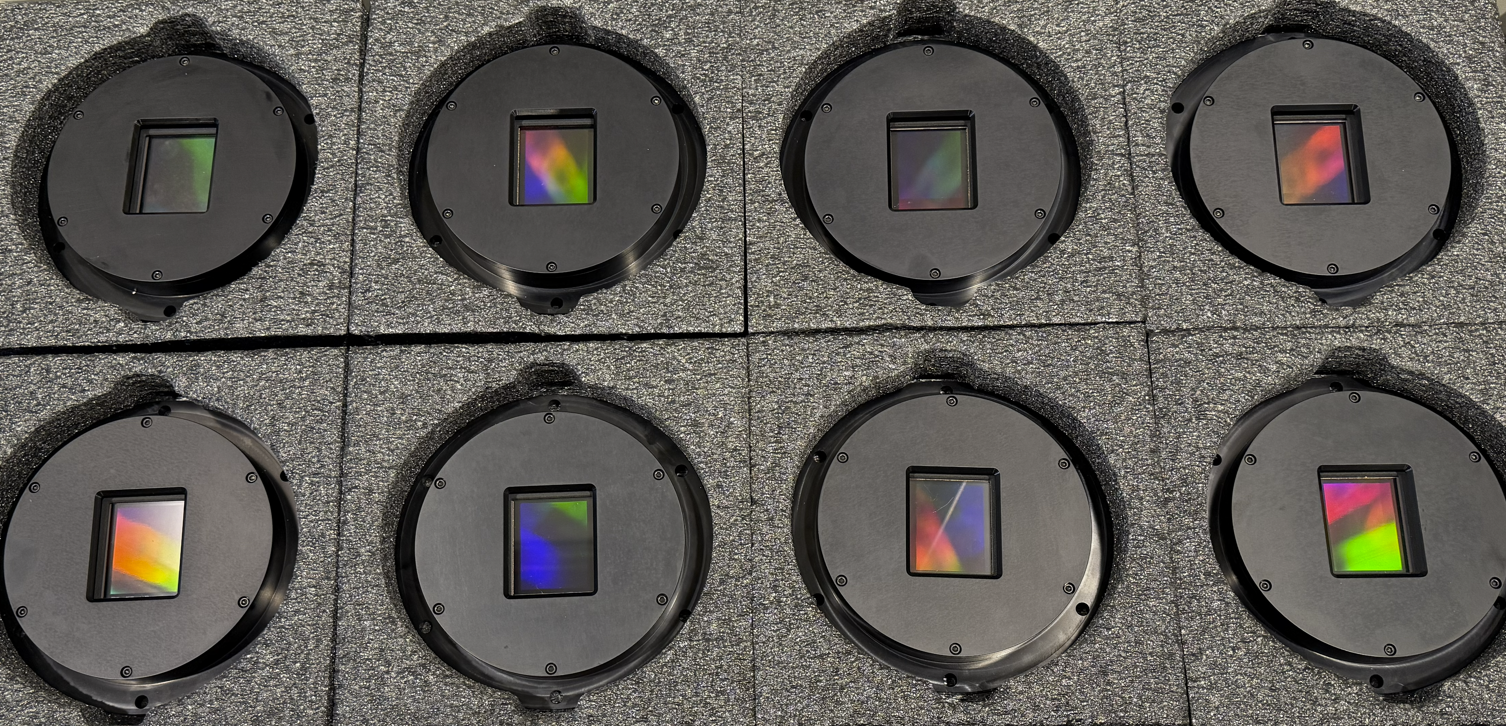 Preparing Argus 461 Cameras for Shipment
Planning a large camera array? Discuss your requirements with our engineering team
Dragonfly Telephoto Array
Diffraction Limited’s experience with large astronomical camera arrays began well before Argus.
The Dragonfly Telephoto Array was developed to detect extremely faint, extended astronomical structures that are difficult to observe with conventional telescopes. Instead of a conventional telescope, Dragonfly combines large numbers of extremely high contrast commercial telephoto lenses and scientific cameras into a coordinated astronomical instrument. Unlike the Argus Array, which continuously observes a vast area of sky, the Dragonfly Array cameras all point at the same part of the sky and perform long integrations. By doing this, the Dragonfly Array can detect extremely faint, extended sources that are far fainter than the sky background.
The Dragonfly Array has made many discoveries, such as seven faint dwarf galaxies around M101, a population of Ultra-Diffuse Galaxies that are as large as the Milky Way but with 1000X fewer stars, a galaxy that is composed almost entirely of dark matter, and another that appears to have almost no dark matter.
An early major configuration of the array used 48 of our SBIG STT-8300 cameras, with 24 camera/lens assemblies installed on each of two telescope mounts.
As Dragonfly expanded, additional mounts and optical systems were added. Diffraction Limited subsequently supplied 150 Aluma CCD694 cameras for the expanded array.
For 85 of these systems, we also supplied a customized version of our StarChaser off-axis guide camera, adapting our guiding technology to the specialized requirements of the instrument.
In total, Diffraction Limited has supplied 198 scientific cameras across multiple generations of the Dragonfly project.
 A Dragonfly Array Segment in Operation
Dragonfly demonstrates an important advantage of the array approach: large numbers of relatively compact, repeatable optical systems can be combined to create a scientific instrument optimized for a capability that would be difficult to achieve with a conventional telescope.
It also demonstrates something important about Diffraction Limited. Our involvement with camera arrays spans multiple projects, detector technologies, camera generations, and system architectures.

Different Arrays for Different Missions
There is no single way to build a camera array.
Common-mount arrays such as Argus and Dragonfly place many independent optical systems on one or more shared telescope mounts. This can greatly reduce the mechanical complexity and cost that would result from independently mounting every telescope.
Other applications benefit from separately mounted telescopes operating as a coordinated system.
Space Domain Awareness is one example. Using multiple telescopes on multiple mounts, arrays can be dynamically configured to search for satellites or to observe a single satellite in multiple spectral bands simultaneously. This allows the system to not just find satellites, but to build a spectral signature of the object.
Separate optical systems can also avoid the back-focus requirements and optical complexity associated with dichroic beam splitters—an important consideration for compact optical systems with limited available back focus. Where appropriate, several telescopes can instead share a common mount.
The optimum architecture depends on the mission. Our role is to make the imaging system work within it.

Designed for Array Integration
A camera array is not simply a collection of standalone cameras.
At array scale, characteristics that may be relatively unimportant for a single instrument become critical: consistency, reliability, serviceability, network management, mechanical integration, configuration control, production traceability, and long-term support.
Diffraction Limited can provide:
High-Speed Networking
10 Gigabit Ethernet provides the bandwidth required by modern large-format sensors while supporting long cable runs and standard network infrastructure.
Custom Mechanical Integration
Camera housings, optical interfaces, mounting arrangements, focus systems, cooling connections, and other mechanical features can be adapted to the telescope or instrument.
Thermal Management
Thermoelectric cooling, air cooling, and liquid cooling can be adapted to the thermal architecture and packaging requirements of the system.
Firmware, API and Network Integration
Camera firmware, APIs, network configuration, remote management, and operating modes can be customized to integrate cameras into larger automated systems.
Production Testing and Traceability
Guided and automated production testing provides consistent characterization while maintaining individual production and calibration records for every camera.
Volume Manufacturing
Our production systems can scale from prototypes and engineering units through sustained volume manufacturing of sophisticated scientific cameras.
Lifecycle Support
Component selection, configuration control, firmware management, documentation, and manufacturing processes can be structured around the expected operating lifetime of a major scientific instrument.
From Prototype to Production
Large scientific instruments rarely begin with a thousand-camera production run.
Diffraction Limited can work with project teams throughout the development process:
Concept → Prototype → Engineering Units → Pilot Production → Full-Scale Manufacturing → Lifecycle Support
Where appropriate, we start with proven camera platforms such as the Aluma AC455, AC461, or AC411 and customize them for the optical, mechanical, electrical, thermal, communications, and software requirements of the instrument.
This approach combines a mature camera architecture with the engineering flexibility required for a purpose-built scientific system.
 Aluma AC461 compared to customized Argus 461 camera
Planning a Camera Array?
Whether your project requires ten cameras or more than a thousand, designing the imaging system involves much more than selecting a detector.
Diffraction Limited brings together scientific camera design, electronics, FPGA firmware, high-speed networking, precision mechanical design, thermal engineering, software, manufacturing, automated testing, and calibration within one organization.
If you are developing a next-generation astronomical survey, telescope array, Space Domain Awareness system, or other large-scale scientific imaging instrument, talk to us early in the design process.
We can help turn your detector and system requirements into a camera architecture that can be manufactured, deployed, and supported at scale.
Discuss Your Project – Use The Contact Form Below