
Platform and Integration
Choose the Imaging Platform Around the Mission
Array telescopes and Space Domain Awareness applications require a balance between field of view, sensitivity, angular sampling, acquisition rate, data throughput and system cost.
Diffraction Limited offers three large-format scientific CMOS platforms spanning 61 to 151 megapixels.
For many SDA systems, the Aluma AC455 is the natural starting point because it provides an excellent combination of sensor area, acquisition speed and cost.
Larger platforms are available where increased focal-plane area provides sufficient system-level benefit.
Custom and semi-custom imaging systems up to approximately 250 megapixels are also available.
Aluma AC455: The Primary SDA Platform
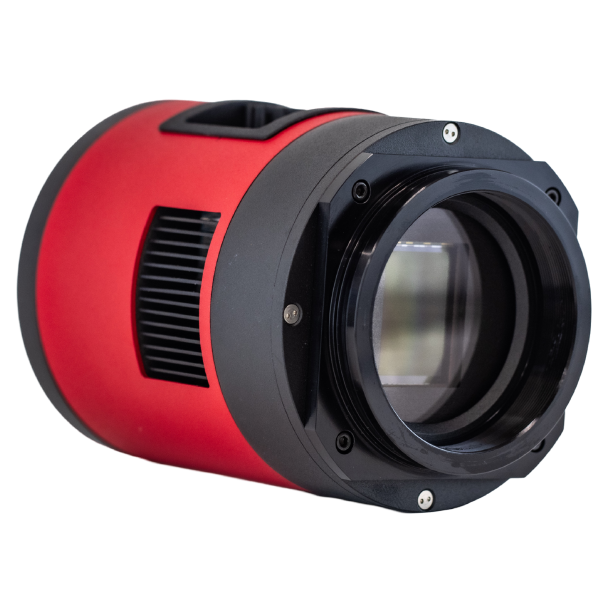
The Aluma AC455 is based on Sony’s back-illuminated IMX455 CMOS sensor. It is an ideal camera for SDA and array applications.
Its combination of a large full-frame focal plane, 3.76 µm pixels, high sensitivity, extremely low read noise, relatively high acquisition rate and comparatively moderate cost makes it particularly attractive for optical satellite detection and tracking systems.
Aluma AC455
Our Aluma AC series cameras produce industry-leading image quality due to our careful attention to detail in engineering the platform. Our highly optimized electronic design provides superior noise performance. The extensive use of copper in our TEC cooling stacks ensures powerful, accurate, and stable thermal regulation. The net result is less noise, fewer hot pixels, and accurate image calibration.
Imaging Sensor
- 61 megapixels
- 9,576 x 6,388 pixels
- 3.76 µm pixel pitch
- Approximately 36 x 24 mm active area
- Approximately 43 mm diagonal
- Back-illuminated CMOS
- High quantum efficiency
- Extremely low read noise ~ 1.1 e- at 3x gain
- High dynamic range
- 16-bit digitization
The large focal plane provides substantial sky coverage while retaining fine angular sampling.
The AC455 is also well suited to multi-camera systems, where camera cost, data volume and acquisition rate become increasingly important as the number of imaging channels increases.
Acquisition Rate Matters
For satellite tracking, acquisition speed can be as important as maximum pixel count.
The AC455 provides a higher full-frame acquisition rate than our larger sensor platforms while producing substantially less data per exposure.
This can be advantageous for:
- Rapidly moving objects
- Repeated astrometric measurements
- Photometric monitoring
- Multi-band synchronized imaging
The AC455 therefore often provides a better overall system tradeoff than simply selecting the largest available sensor.
Aluma AC461: Greater Field of View
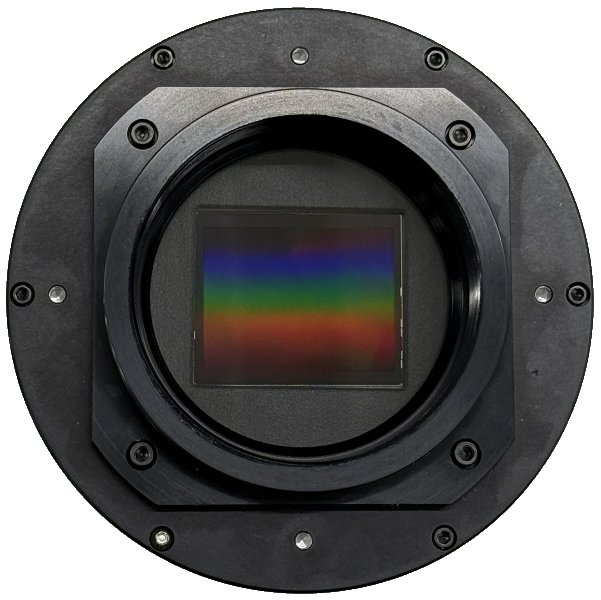
A good match for telescopes with a large illuminated field, the Aluma AC461 provides the same fine pixel sampling as the AC455 over a substantially larger focal plane. This is the ideal camera for large survey instruments.
Aluma AC461
The Aluma AC461 is based on Sony’s 102-megapixel IMX461 sensor.
- 102 megapixels
- 11,664 x 8,750 pixels
- 3.76 µm pixel pitch
- Approximately 44 x 33 mm active area
- Approximately 55 mm image diagonal
- Back-illuminated CMOS
- High quantum efficiency
- Extremely low read noise ~ 1.1 e- at 3x gain
- High dynamic range
- 16-bit digitization
Because the AC461 uses the same 3.76 µm pixel pitch as the AC455, moving to the larger camera increases the field of view without materially changing angular sampling for a given optical system.
The AC461 is therefore attractive where maximizing instantaneous sky coverage justifies the additional sensor cost, data volume and lower acquisition rate.
Aluma AC411: Maximum Focal-Plane Area
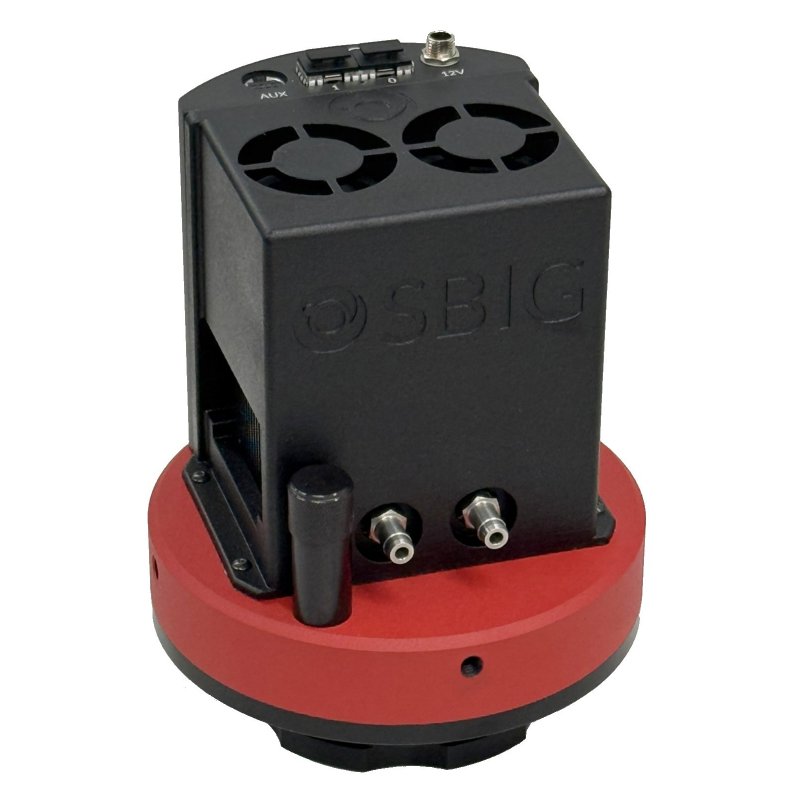
The Aluma AC411 extends the platform range to 151 megapixels. This camera is ideal for applications where maximum focal-plane area and sky coverage take priority over cost and data volume.
Aluma AC411
The Aluma AC411 is based on Sony’s 151-megapixel IMX411 sensor.
- 151 megapixels
- 14,208 x 10,656 pixels
- 3.76 µm pixel pitch
- Approximately 53 mm x 40 mm active area
- Approximately 66 mm image diagonal
- Back-illuminated CMOS
- High quantum efficiency
- Extremely low read noise ~ 1.1 e- at 3x gain
- High dynamic range
- 16-bit digitization
The AC411 may be particularly useful for systems where increasing the sensor area can reduce the required number of telescopes, increase instantaneous sky coverage, or provide additional flexibility in optical design.
System Integration
Diffraction Limited’s Aluma AC series cameras are designed for high-performance array applications such as sky surveys and Space Domain Awareness.
Designed for Networked Imaging Systems
All of Diffraction’s high-performance cameras use 10 Gigabit Ethernet over SFP+ fiber for image transfer and control.
This is particularly well-suited to observatories and distributed imaging installations because it provides:
- High data throughput
- Long-distance fiber connections
- Electrical isolation
- High immunity to electrical noise
- Standard Ethernet infrastructure
- Multiple cameras on a common network architecture
- Flexible placement of processing hardware
In a multi-telescope installation, each camera can operate as a networked imaging device rather than requiring a dedicated short-distance peripheral connection to its host computer.
This greatly simplifies physical installation and allows the acquisition architecture to scale more naturally as additional telescopes or cameras are added.
Precision Image Timing and Synchronization
All of our Aluma AC models support optional timing and synchronization methods. For a single instrument our ATU-1 Astronomical Timing Unit module facilitates GPS-based timestamps on every image. PTP support is available for larger systems.
Precision triggering is available via external hardware trigger, broadcast UDP message, or GPS or PTP timestamp. Multiple cameras can be triggered to expose simultaneously within ~50 nanoseconds.
This supports:
- Satellite astrometry
- Orbit determination
- Orbit refinement
- Fast-moving object observations
- Coordinated multi-camera measurements
- Coordinated observations between geographically separated sites
Timing information is associated directly with the camera acquisition process rather than depending solely on the operating-system clock of the acquisition computer.
Selecting a Platform
For most large-format optical SDA applications, we recommend beginning the trade study with the AC455.
The other platforms become attractive when additional focal-plane area provides a meaningful system-level advantage.
| Platform | Primary Advantage | Typical Reason to Select |
| AC455 | Best overall balance | Acquisition rate, cost, multi-camera systems |
| AC461 | Larger focal plane | Greater instantaneous field of view |
| AC411 | Maximum focal-plane area | Maximum sky coverage |
| Custom | Your choice of sensor | Optimized for optical system, packaging, special features |
The optimum configuration depends on the complete optical and acquisition system rather than pixel count alone.
Important parameters include telescope aperture and focal length, required field of view, angular sampling, object brightness and angular velocity, exposure duration, acquisition cadence, timing accuracy, number of cameras, data-processing architecture and expected production quantity.
Software API
Our fully documented software API is supported under Windows 11 x64 and Linux Ubuntu 22.04 LTS. Other operating systems are available upon request. The API is designed to be extensible and flexible to meet specialized customer requirements. An ASCOM interface is also available for integrating with COTS software packages.
Thermal Integration
Aluma AC cameras provide regulated thermoelectric sensor cooling, with air- and liquid-cooled configurations available. For multi-camera and remote installations, liquid cooling can simplify system thermal management by transferring camera heat away from the telescope structure and into a centralized cooling system. Custom cooling interfaces can be provided for OEM and array applications.
Customization
Diffraction Limited can provide a wide range of options ranging from standard add-ons to full-custom systems, including:
- Filter wheels
- GPS timing unit
- Custom firmware functions
- Modified mechanical packaging and interfaces
- Custom electrical interfaces
- Choice of imaging sensor
- Custom communications interfaces and functions
- Complete custom instrumentation
Our imaging platform’s inherent flexibility means that we can adapt our systems to meet your needs.
For large deployments, camera configuration, network addressing and firmware management can be adapted to support centralized system administration.
Discuss Your Imaging Requirements
Our engineering team can work with telescope designers and system integrators to evaluate the complete imaging trade space.
Useful starting information includes telescope aperture and focal length, desired field of view and pixel scale, target characteristics, exposure and acquisition requirements, timing accuracy, number of cameras, interfaces, environmental conditions and anticipated production quantity.
Discuss Your Project – Use The Contact Form Below